
Why I Stopped Reading Articles about Success
shoemoney
·
·
5 min read
 Lately, as I've been getting all kinds of experiences trying to raise money for my startup the PAR Program, I've been thinking a lot about what makes people successful.
Sure I've sold a few companies, and I wrote a lot about this topic, but I don't think there is one single successful person that thinks about this topic when they hit some snags. If you're trying to hit new level, you're going to hit new challenges. As a wise man once said "new level, new devil".
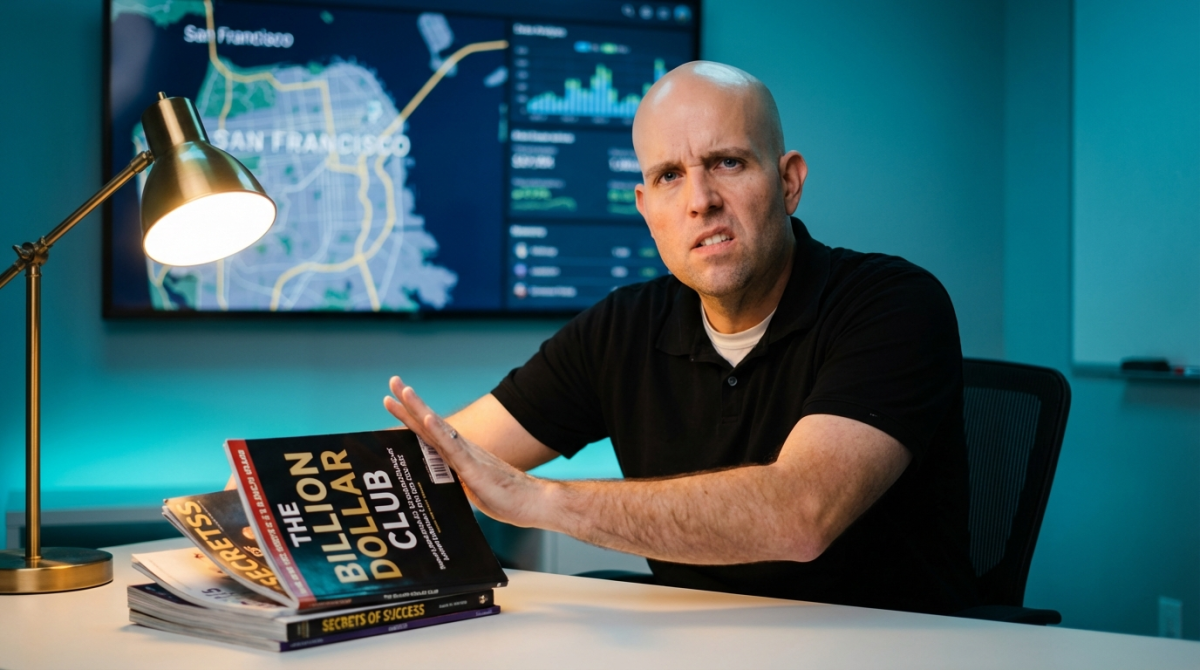
But one thing that really pisses me off are these articles about what makes people "successful". For example, Techcrunch wrote an article about the "billion dollar club" and the patterns they were able to extract about what made these companies successful.
I don't read them. Why? Because these articles are basically circle jerks - articles written to please the readers, not to actually tell it like it is.
Lately, as I've been getting all kinds of experiences trying to raise money for my startup the PAR Program, I've been thinking a lot about what makes people successful.
Sure I've sold a few companies, and I wrote a lot about this topic, but I don't think there is one single successful person that thinks about this topic when they hit some snags. If you're trying to hit new level, you're going to hit new challenges. As a wise man once said "new level, new devil".
But one thing that really pisses me off are these articles about what makes people "successful". For example, Techcrunch wrote an article about the "billion dollar club" and the patterns they were able to extract about what made these companies successful.
I don't read them. Why? Because these articles are basically circle jerks - articles written to please the readers, not to actually tell it like it is.
Remember, this article was written by a venture capitalist who lives in bay area and is writing for tech people, who mostly want to be in tech & in bay area. But if you were to read this, you would think.
- Companies fall somewhat evenly into four major business models: consumer e-commerce, consumer audience, software-as-a-service, and enterprise software.
- It has taken seven-plus years on average before a “liquidity event” for companies, not including the third of our list that is still private. It’s a long journey beyond vesting periods.
- Inexperienced, twentysomething founders were an outlier. Companies with well-educated, thirtysomething co-founders who have history together have built the most successes
- San Francisco (not the Valley) now reigns as the home of unicorns.
- Ninety percent of co-founding teams comprise people who have years of history together, either from school or work; 60 percent have co-founders who worked together; and 46 percent who went to school together.
Result? You'd think you can't be part of the billion dollar club. That's why I don't read these articles either. They don't talk about the one guy toiling away and ends up makeing it. They don't about that guy in Nebraska building a kick ass marketing software. They don't talk about anything that doesn't resemble what they want to see. I'm not going to lie. When I read these articles, they make me think for a second, "do I have what it takes?". Then I realize these articles were written not for their true substance, but for entertainment purpose. One of the ways is to give them what they want to read so that they'll keep reading and buying more of their shit, so that these media companies can sell more ads. So, I say .. screw them. Let me tell you a contrary point of view.
- oh wait, i'm not that young
- oh wait, i ain't in consumer-anything
- oh wait, i don't live in SF
- oh wait, i work alone
1) "You can't build a huge business without co-founders"
Yeah i would agree that it's definitely easier to start a company with people. It's like workign out - your chances of losing weight and getting in shape is exponentially higher when you have a workout buddy that you're accountable to, not to mention it's way more motivating. But at the same time, I wouldn't necessarily make a prediction that solo founders won't be successful just because they work alone. For example:- Amazon (Jeff Bezos)
- Walmart (Sam Walton)
- eBay (Pierre Omidyar)
- FedEx (Fred Smith)
- Spanx (Sara Blakely)
- PlentyOfFish (Marcus Frind)
- ClickAgents/BlueLithium (Gurbaksh Chahal)
- KFC (Harland Sanders)
- Wendys (Dave Thomas)
2) "Starting business with your husband/wife/family is a bad idea
VCs are notorious for being anti-family business (here's why). I think these families did alright:- Cisco Systems (Leonard Bosack & Sandra Lerner)
- McDonalds (Richard and Maurice McDonald, granted they sold to Ray Kroc)
- WebMethods ( Phillip & Caren Merrick, acquired by Software AG)
- Clif Bar & Co. (Gary Erickson and Kit Crawford )
- Fiji Water (Lynda and Stewart Resnick)
- VMWare ( Diane Greene and Mendel Rosenblum)
- Flickr (Stewart Butterfield and Caterina Fake)
3) If you're not in Silicon Valley or NYC, you have no chance.
If "billion" is about the only measure of success, I would say people outside these two areas did alright: Ok, you want US? Statistically speaking, Connecticut or Nevada seems like a better choice than California (where all the "innovation" is happening)
 By the way.. the richest (or 2nd richest dude) isn't even American. Carlos Slim Helu lives in Mexico!