

Be a Strategist, Not an Opportunist
shoemoney
·
·
3 min read
Last week I came across an awesome presentation titled “Things I will Tell My Kids if They Become Entrepreneurs.” All the slides and points presented are spot on (which is quite a feat considering there are 127 slides on the presentation!). There was one in particular that made me pause and think for a good while:
 Opportunistic behavior is especially dangerous for webmasters and digital entrepreneurs. Setting up a website or developing an app to go after an opportunity is quite easy these days, so you might be tempted to do so frequently. As a result you'll waste time and energy that could be used toward your main project and goals.
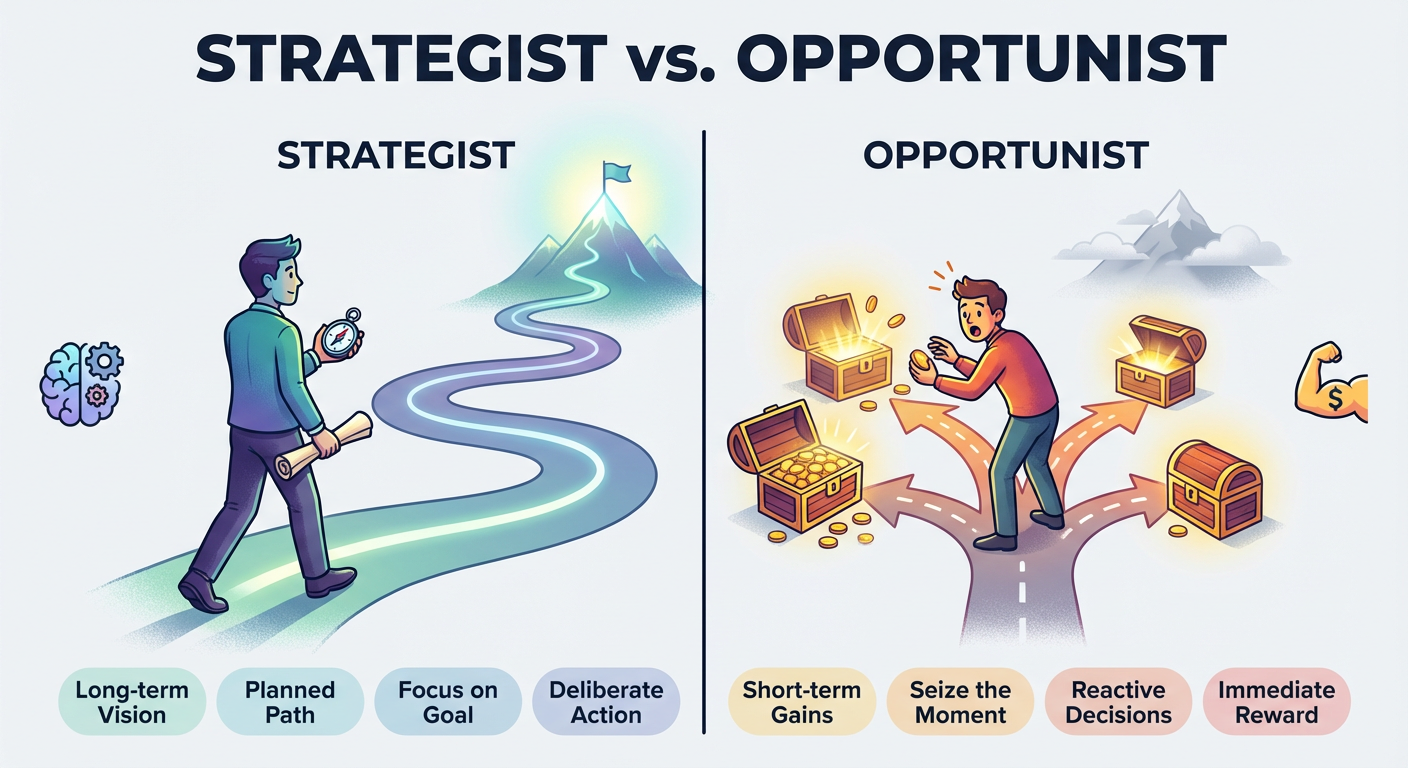
Being a strategist involves having a clear vision about what you are trying to accomplish, and how you are going to get there. Practically speaking, it means knowing what kind of company or products you want to build, what kind of customers you want to serve and so on.
Here’s one important caveat: the idea is not to stop pursuing all opportunities. It’s to stop pursuing opportunities that do not align with your long-term goals and strategy. You should still keep your radar on and monitor the market to identify opportunities that will help you achieve your goals faster, and when those come along, go after them!
For me, money is the villain. As an entrepreneur, I am always thinking about business ideas that could fly, existing problems that I could solve while making a profit and so on. Sometimes I am not so focused on my current projects (the ones connected with my long-term goals) and I end up pursuing those short-term opportunities. What is worse, more often than not I lose money on them because they are just short-term experiments, receiving just a small amount of my attention and energy.
Bottom line: Be a strategist and not an opportunist! Know what your long-term goals are, and have a strategy to achieve them, rejecting opportunities that don't fit in.
Opportunistic behavior is especially dangerous for webmasters and digital entrepreneurs. Setting up a website or developing an app to go after an opportunity is quite easy these days, so you might be tempted to do so frequently. As a result you'll waste time and energy that could be used toward your main project and goals.
Being a strategist involves having a clear vision about what you are trying to accomplish, and how you are going to get there. Practically speaking, it means knowing what kind of company or products you want to build, what kind of customers you want to serve and so on.
Here’s one important caveat: the idea is not to stop pursuing all opportunities. It’s to stop pursuing opportunities that do not align with your long-term goals and strategy. You should still keep your radar on and monitor the market to identify opportunities that will help you achieve your goals faster, and when those come along, go after them!
For me, money is the villain. As an entrepreneur, I am always thinking about business ideas that could fly, existing problems that I could solve while making a profit and so on. Sometimes I am not so focused on my current projects (the ones connected with my long-term goals) and I end up pursuing those short-term opportunities. What is worse, more often than not I lose money on them because they are just short-term experiments, receiving just a small amount of my attention and energy.
Bottom line: Be a strategist and not an opportunist! Know what your long-term goals are, and have a strategy to achieve them, rejecting opportunities that don't fit in.
Opportunistic ≠Strategist You can either pursue every opportunity - in which case you are not really deciding where you are going - or have a clear strategy and reject opportunities that don’t fit it. Opportunities will take you somewhere fast, strategy will take you somewhere far.I am not sure about you, but I am guilty of pursuing opportunities that weren’t necessarily aligned with my long term goals and strategy, so when I read that slide it struck a chord. The presentation only says that being an opportunist is different than being a strategist. I would go one step further and say that they are almost the opposite of each other (under an entrepreneurial point of view). If this is the case, it becomes easy to see why the opportunistic behavior should be avoided. Being a strategist is a good thing, a virtue you can have. The opposite, therefore, must be a bad thing and avoided.
Opportunistic behavior is especially dangerous for webmasters and digital entrepreneurs. Setting up a website or developing an app to go after an opportunity is quite easy these days, so you might be tempted to do so frequently. As a result you'll waste time and energy that could be used toward your main project and goals.
Being a strategist involves having a clear vision about what you are trying to accomplish, and how you are going to get there. Practically speaking, it means knowing what kind of company or products you want to build, what kind of customers you want to serve and so on.
Here’s one important caveat: the idea is not to stop pursuing all opportunities. It’s to stop pursuing opportunities that do not align with your long-term goals and strategy. You should still keep your radar on and monitor the market to identify opportunities that will help you achieve your goals faster, and when those come along, go after them!
For me, money is the villain. As an entrepreneur, I am always thinking about business ideas that could fly, existing problems that I could solve while making a profit and so on. Sometimes I am not so focused on my current projects (the ones connected with my long-term goals) and I end up pursuing those short-term opportunities. What is worse, more often than not I lose money on them because they are just short-term experiments, receiving just a small amount of my attention and energy.
Bottom line: Be a strategist and not an opportunist! Know what your long-term goals are, and have a strategy to achieve them, rejecting opportunities that don't fit in.